Why a Credit Union Lending Stack Needs More Than an LOS
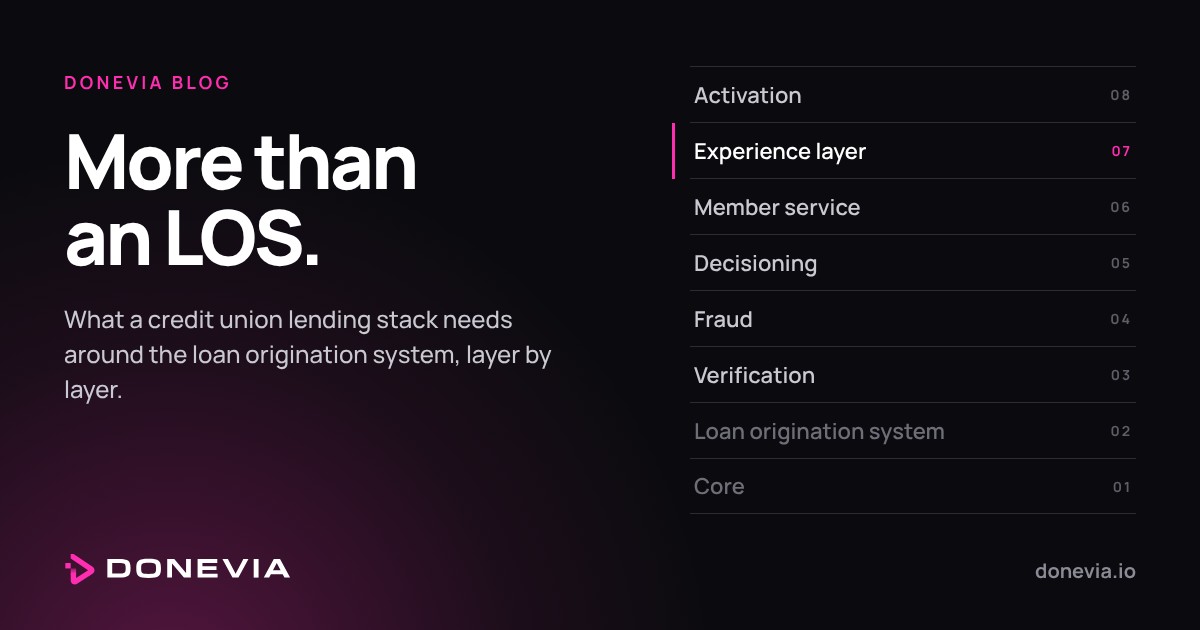
Your LOS records the loan. It doesn't verify income, catch a straw borrower, answer the phone, or notice the paystub a member texted at 9 PM.
That's not a knock on the LOS. It's just not what it's for. The credit unions moving fastest aren't replacing theirs. They're adding a few focused tools around it. Here are four combinations that work, and who's already doing it.
Stack 1: Indirect auto that turns into members
Point Predictive + Swaystack, with Zest AI if you want more auto-decisions.
Indirect auto brings volume, but two things go wrong. Fraud slips in through the dealer channel, and the borrower never becomes a real member. They have a car loan with you and everything else somewhere else.
- Before funding: Point Predictive scores each application for fraud and checks stated income and employment, so clean deals can skip the extra docs and risky ones get a second look.
- At decision: Zest AI models let more of those applications decide automatically.
- After funding: Swaystack runs a guided, gamified onboarding path inside digital banking: open checking, move direct deposit, turn on e-statements.
Who's doing it: Dort Financial Credit Union, which is growing indirect auto quickly, added Point Predictive's AutoPass, IEValidate and DealerCheck in March 2026. Family Financial Credit Union uses Swaystack inside Jack Henry Banno specifically to turn dormant accounts and indirect loans into funded relationships.
Stack 2: Stips that clear themselves
Truv + Donevia.
Most consumer loans don't wait on a credit decision. They wait on proof of income, then on a loan officer to notice it came in.
- Truv lets the member verify income and employment straight from their payroll provider in a few taps, instead of digging up a paystub.
- When a member does send a document, Donevia picks it up, runs a fraud check, scrubs personal information before any AI sees it, files it, and drafts the next step. The loan officer approves it with one click.
What it looks like: a member applies for a personal loan at lunch, verifies income on their phone, and by the time the loan officer is off their next call, the file is updated and a "you're ready to sign" text is waiting for approval. I wrote more about this gap in The Follow-Up to the Follow-Up.
Stack 3: AI underwriting for a small credit union
Zest AI through a CUSO + Donevia.
Small credit unions often can't build or maintain an AI credit model alone. They don't have to anymore.
- The CU Lending Collective, a CUSO launched in February 2026 by Commonwealth Credit Union and Zest AI, gives small and midsized credit unions custom AI models for auto, personal loans and credit cards, with the fair-lending and model-risk documentation examiners ask for.
- Faster decisions only help if the next step happens. Donevia turns each approval into a drafted member message and next step, so the loan officer isn't the bottleneck.
Who's doing it: Commonwealth says its loans grew more than 14% in 2025 after it started using Zest AI, with strong delinquency and charge-off performance.
Stack 4: Get the phones off your loan officers' desks
interface.ai + Donevia.
"Did you get my document?" "When's my payment due?" Each call is two minutes. Forty of them is a morning.
- interface.ai voice agents answer routine calls end to end: authenticate the member, look up the answer, route the rest.
- For calls about an open loan, Donevia turns the conversation into a next step on that file, so nothing depends on someone's sticky note.
Who's doing it: Navigator Credit Union and Red Rocks Credit Union were among the first to go live with interface.ai's agentic voice AI. Navigator says it now handles everyday calls so its smaller team can focus on higher-value conversations. Red Rocks calls its assistant Roxie.
Where to start
| If your problem is… | Start with |
|---|---|
| Loans waiting on paystubs and callbacks | Truv + Donevia |
| Rising indirect fraud or early defaults | Point Predictive |
| Too many manual credit reviews | Zest AI |
| Loan officers stuck on routine calls | interface.ai + Donevia |
| Indirect borrowers who never open checking | Swaystack |
Not sure which row is yours? Pull ten slow loans from last month and write down what each one was waiting on. The answer is usually obvious by the fifth one.
Before you sign anything, ask every vendor one question: which of our systems do you already connect to, and how long did that take for a credit union like ours?
Eli Christiansen
Founder and CEO, Donevia
Frequently asked questions
Do we need to replace our LOS to add these tools?
Usually not. Each of these tools is built to work alongside the LOS, core or digital banking platform a credit union already runs. Ask each vendor which of your systems they already connect to.
Which layer should a credit union add first?
Start where your loans wait. Documents and callbacks point to verification and follow-up. Manual reviews point to decisioning. Rising indirect losses point to fraud.
Does Donevia replace our LOS or CRM?
No. Donevia is an AI experience layer that works alongside your core, LOS and CRM. It turns leads, emails, calls, status changes and document uploads into next steps a loan officer confirms, edits or denies with one click. Nothing reaches a member without a person saying yes.